# The Marketplace as Your Strategic Partner: Making Better Decisions Every Day
P

Pibasacro
Jul 24, 2026 · EN
62
10
7
Earned
4,175.99 MGA · the local value of 0.0001 gold from the author's country treasury for every read and every like
# The Marketplace as Your Strategic Partner: Making Better Decisions Every Day
Every city reaches a point where simply producing more is no longer enough. In the beginning, expanding your industries seems like the obvious solution to every challenge. Need more food? Build another farm. Need more wood? Expand your forestry operations. Need more clothing? Construct another textile factory.
This approach works well during the early stages of the game, but it quickly becomes expensive. Every new building requires land, workers, maintenance, and investment. Before long, you may find yourself managing dozens of production chains while still struggling to satisfy every need.
That is why experienced players rely on the Marketplace.
The Marketplace is not just a place where resources are bought and sold. It is a decision-making tool that helps you use your money, your workers, and your production capacity more efficiently. Instead of asking, "What should I build next?" successful players often ask, "Should I build it at all?"
Sometimes the best investment is not a new factory.
Sometimes it is a smart purchase from another player.
The Marketplace gives you that freedom.
Unlike ordinary stores found in many games, the Marketplace is powered entirely by players. Every product listed for sale has been produced, collected, or earned by another city. Every offer represents someone's business strategy. Every purchase supports another player's economy while helping your own.
This creates an economy that feels alive.
Prices are always changing because players are constantly producing, buying, and selling. If hundreds of cities harvest large quantities of grain, the market becomes well supplied and prices may decrease. If construction activity suddenly increases across the server, demand for stone and timber rises, often pushing prices upward.
These movements are not random. They reflect the behavior of thousands of real players making economic decisions every day.
Fortunately, you do not need to monitor every price change.
Instead, focus on understanding the role the Marketplace plays in your city's development.
Think of it as your economic safety net.
Whenever your warehouse lacks an important resource, the Marketplace gives you immediate access to new supplies. Whenever your production exceeds your city's needs, the Marketplace provides customers ready to purchase your surplus.
This balance is incredibly valuable.
Without trade, shortages could stop production for hours, while excess inventory would occupy valuable warehouse space. Thanks to the Marketplace, both problems can often be solved with a few simple transactions.
Another major advantage is flexibility.
Imagine that your city specializes in producing furniture. Your sawmills generate plenty of timber, and your workshops transform that timber into profitable products. Suddenly, an opportunity appears to expand your furniture production even further.
Should you also invest in mining, farming, and every other supporting industry?
Not necessarily.
You might decide to purchase the additional resources you need from other players while concentrating your investments on the industries where your city already excels.
This strategy allows your economy to grow faster while reducing unnecessary construction costs.
The Marketplace rewards specialization.
Rather than trying to become self-sufficient in every area, players can focus on their strongest industries and trade for everything else. This creates a healthy economic environment where different cities naturally support one another through commerce.
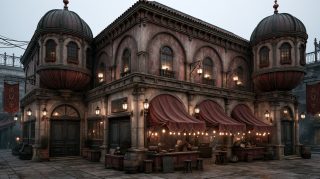
To make navigation simple, the Marketplace is organized into four major sections.
The first is the **Raw Materials Market**. This is where industries obtain the basic resources needed for production, including timber, stone, clay, grain, metals, agricultural products, and gold ore.
The second is the **Consumer Goods Market**. Finished products such as food, beverages, clothing, tobacco, and jewelry are traded here. These goods help satisfy the needs of your population and contribute to the prosperity of your city.
The third is the **People Market**, where workers and specialists are exchanged. Growing businesses often require additional labor, while changing economic conditions sometimes create surplus workers. This market allows cities to adapt quickly.
The fourth is the **Share Market**, where CoinRepublik shares are bought and sold using GOLD. Instead of physical products, players exchange investments that represent another dimension of the game's economy.
Although these markets contain different assets, they all operate according to the same simple process. Select the item you need, compare the available offers, choose the best option, and complete the transaction. Selling follows the same principle: decide what to sell, choose a competitive price, and wait for another player to make the purchase.
One of the most valuable habits you can develop is comparing prices before making any decision.
The cheapest offer is not always available for long, while the highest-priced listing may never sell. Looking at several offers gives you a better understanding of the market and helps you avoid unnecessary expenses.
Another useful habit is planning ahead.
Do not wait until your warehouse is completely empty before buying essential materials. Likewise, do not allow surplus goods to accumulate indefinitely. Regular trading keeps your production flowing smoothly and your warehouse organized.
As your city expands, you will gradually recognize market trends.
Some products remain in constant demand because every city needs them. Others experience periods of high demand followed by temporary declines. Watching these trends helps you identify profitable production opportunities without requiring complicated calculations.
Remember that consistency is more important than perfection.
A player who makes sensible decisions every day usually performs better than someone who waits endlessly for the perfect trade.
The Marketplace also simplifies logistics.
Every purchase is delivered directly into your city's shared warehouse. There is no transportation network to manage and no additional delay before your businesses can use the resources.
This means that goods purchased from another player become part of your economy almost instantly.
The same warehouse stores everything your own businesses produce, making inventory management simple and efficient.
Perhaps the greatest lesson the Marketplace teaches is that wealth is created through cooperation as much as through production.
Every city has strengths.
Every city has weaknesses.
Trade allows players to exchange those strengths, creating benefits for everyone involved.
A mining city can supply metals to industrial manufacturers.
Agricultural communities can feed growing populations.
Luxury producers can serve wealthy cities looking for premium goods.
Instead of competing in every industry, players become partners in a much larger economy.
That is what makes the Marketplace so rewarding.
It is not simply a place where products change hands.
It is where individual cities become part of something much bigger.
Every trade strengthens economic connections.
Every purchase keeps industries running.
Every sale transforms production into new investment opportunities.
The cities that prosper over the long term are not necessarily those with the most factories or the largest populations. They are the cities led by mayors who understand when to produce, when to buy, when to sell, and when to let the Marketplace work in their favor.
Master that balance, and your city will continue to grow with confidence, stability, and lasting prosperity.